Structural engineering consultancy for adaptations in industrial projects is a topic that is necessary to address and carry out in every construction project today. The aim of structural consultancy is to ensure that buildings can withstand the effects of an earthquake and prevent the consequences (and potential disasters) observed in earthquakes until now. However, we must go beyond this simple description and ask ourselves the following:
How resistant do I want my structure to be?
It is possible to know what the building should withstand, but achieving a building that can withstand all potential seismic events would result in an excessively robust and costly structure. However, there are several international codes designed to strike a middle ground known as the philosophy of seismic-resistant design, which is classified according to the Mercalli scale.
How do structural engineers achieve this?
To meet the expectations of seismic-resistant design, all engineers determine the maximum seismic forces that can be expected in a potential seismic event.
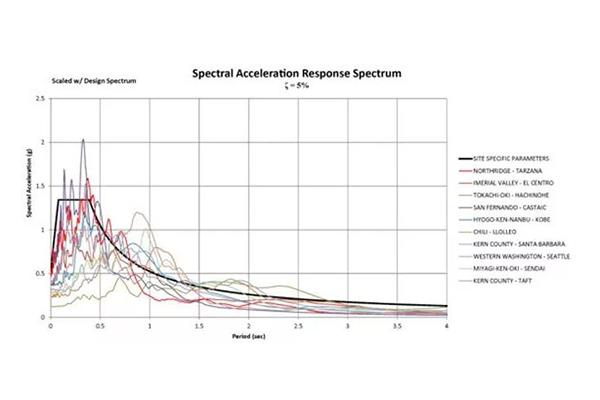
All engineers have access to a great tool called the Seismic Spectrum. With the help of this spectrum and using the principles of dynamics, engineers can estimate a seismic force that will be the basis of all seismic-resistant design of our building.
What is the Response Spectrum?
The Seismic Spectrum, in simple terms, is a graph that summarizes the maximum oscillation accelerations that a building can have, depending on its natural vibration period. To clarify this further, we break down the concepts a bit.
Every earthquake that has occurred on earth is described as a signal that, when applied to a building, causes it to vibrate, oscillate, or move in a particular way. If we gather several known seismic signals, we can derive an average curve, which is the Seismic Spectrum.
This acceleration will depend on the natural vibration period of my building. This natural or fundamental period is the time it will take for a building to perform an oscillation (i.e., move from side to side) when subjected to an external force such as that of an earthquake.
There are 3 factors to consider in structural design and assistance: seismic zoning, soil type, and structural system.
Seismic zoning
Seismic zoning is determined by monitoring and analyzing a large amount of data during seismic events, grouping the data to determine regionalization. In Mexico, there are 4 different seismic regions congruent with their proximity to tectonic faults, soil type, and historical seismic events, providing a geographical segmentation.
Soil type
Soil type must be detected independently of the seismic zoning in order to determine the characteristics of the soil. Exploration and preliminary studies, such as geotechnics, hydrology, geophysics, and soil mechanics, allow us to clarify the soil’s resistance and response to the soil-structure interaction.
Structural system
The appropriate structural system for the project is chosen through a Value Engineering process, which evaluates the safety, performance, and cost of potential structural systems, showing the advantages and disadvantages of each. The goal is to arrive at the optimal solution, whether with concrete or metallic elements.
Knowledge of these factors requires extensive experience, especially for projects designed in high seismicity zones. The analysis and design should be performed by specialized professionals in structural and civil engineering with broad knowledge in creating mathematical models that simulate seismic events to create structural systems that can withstand them.